“Oh… It’s just a Brown-eared Bulbul”
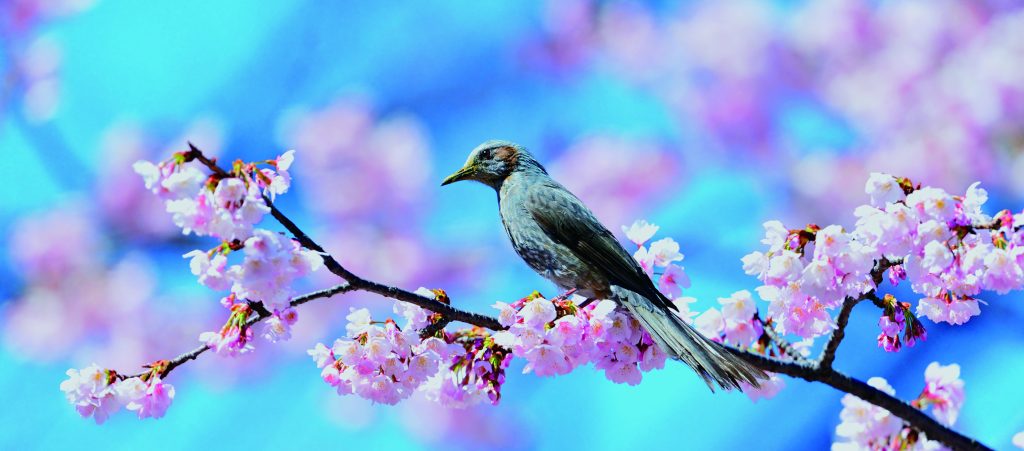
We should not disregard common birds such as Brown-eared Bulbul, as HIH Princess Takamado explains with a selection of her bird photos.
“Through the Lens” Fujingahou Magazine, April 2026
Photos and text by HIH Princess Takamado
Photo edited by Koichi Fujiawara (NATURE’S PLANET)
Edited by Yuki Masuda (Fujingahou)
English version prepared by BirdLife International.
(This English version is provided for reference only and does not constitute an official version)
At last, the cold has begun to ease, and it is now the season of gentle spring breeze. In recent years, I feel spring and autumn have gradually been growing shorter, perhaps due to climate change. This is truly regrettable as they are both such beautiful seasons. In this installment, I will feature birds that will help you feel the spring: Brown-eared Bulbuls.
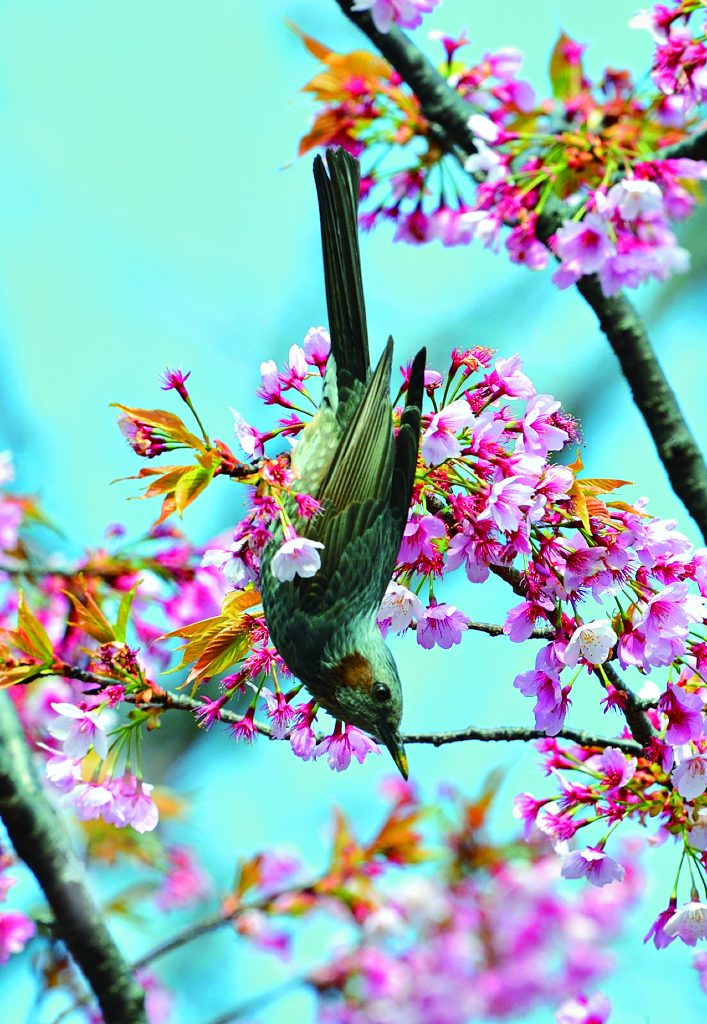
27.5 cm; Pycnonotidae Family
The yellow on the tip of the bird’s beak is pollen. From winter to spring, Brown-eared Bulbuls and flowers maintain a co-operative relationship. During the food-scarce winter months, the bulbuls drink nectar, while the flowers deposit pollen on to the birds, enabling pollination as they visit other blossoms. All photographs were taken within the Akasaka Estate (Imperial residence).
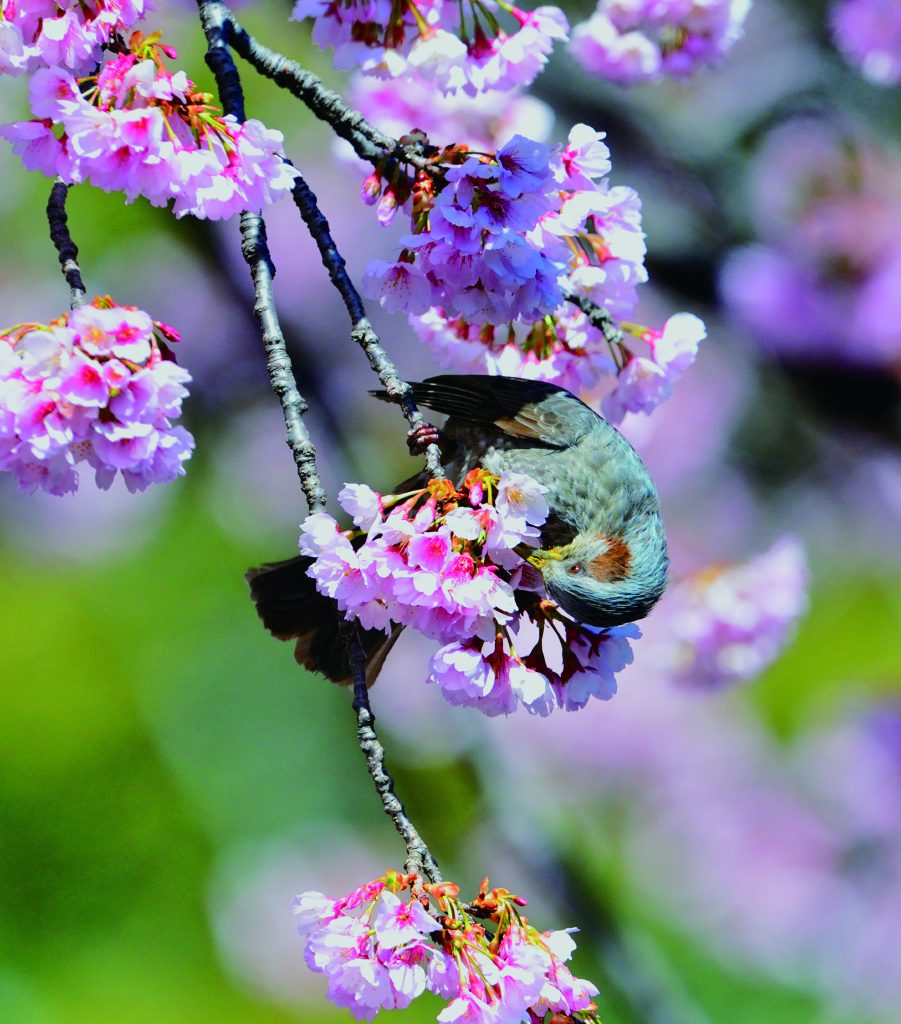
It was given its Japanese name hiyodori after its calls, which sound like “hee-yo, hee-yo.” For Japanese people, it is one of the most familiar birds after sparrows and crows. At first glance, it may appear plain, but when you look closely, you discover it has a rather charming appearance. However, it is so common that one often hears the dismissive remark, “Oh… it’s just a Brown-eared Bulbul,” as if it were hardly worth observing even at birding gatherings filled with enthusiasts.
Brown-eared Bulbuls have a strong sense of territory. They drive away other birds visiting camellias or cherry blossoms, making them seem rather mean. Their loud, piercing cries shatter the silence, so they are also sometimes considered annoying. Perhaps for these reasons, they are unfortunately not very well loved among Japanese people.
Interestingly, however, they are quite popular among birders visiting Japan from overseas. One reason is their limited distribution. They inhabit East Asia, mainly in Japan, making many foreign visitors eager to see them during their stay in the country.
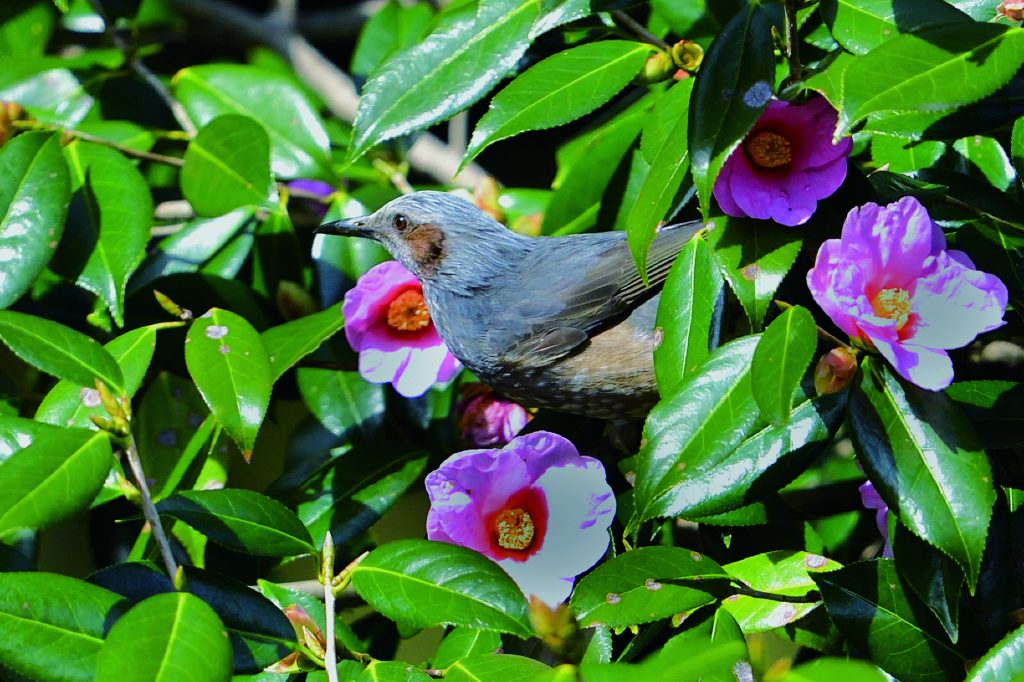
Today, Brown-eared Bulbuls can be seen year-round in urban areas. In my childhood, however, I do not recall ever hearing their loud calls despite the abundant greenery near my family home in central Tokyo. Nor do I remember seeing them in our garden. In fact, until about 50 to 60 years ago, they primarily inhabited satoyama forests (secondary woodlands traditionally managed by local communities) at elevations of between 400 to 1,000 meters, descending to lower plains during winter. It is said that their expansion into urban areas is related to the increase in ‘greening’ in such spaces.
Another factor supporting their move into cities has been the wide variety of available food. Brown-eared Bulbuls are omnivores. In addition to the camellias and cherry blossoms shown in the photographs, they feed on nectar from plum, apricot, and other blossoms, willow buds and young leaves, insects, and the berries of street trees such as nandina and pyracantha. They never run short of food throughout the year because they can drink sap from broken branches, and find fully ripened fruits such as persimmons, mandarins, grapes and apples, and leafy vegetables such as cabbage and Chinese cabbage in suburban areas.
They breed in city parks, residential areas, and private gardens. For nest materials, they use not only twigs and plant fibres but also vinyl and plastic. Their skilful use of materials found within human living spaces demonstrates their tough way of surviving.
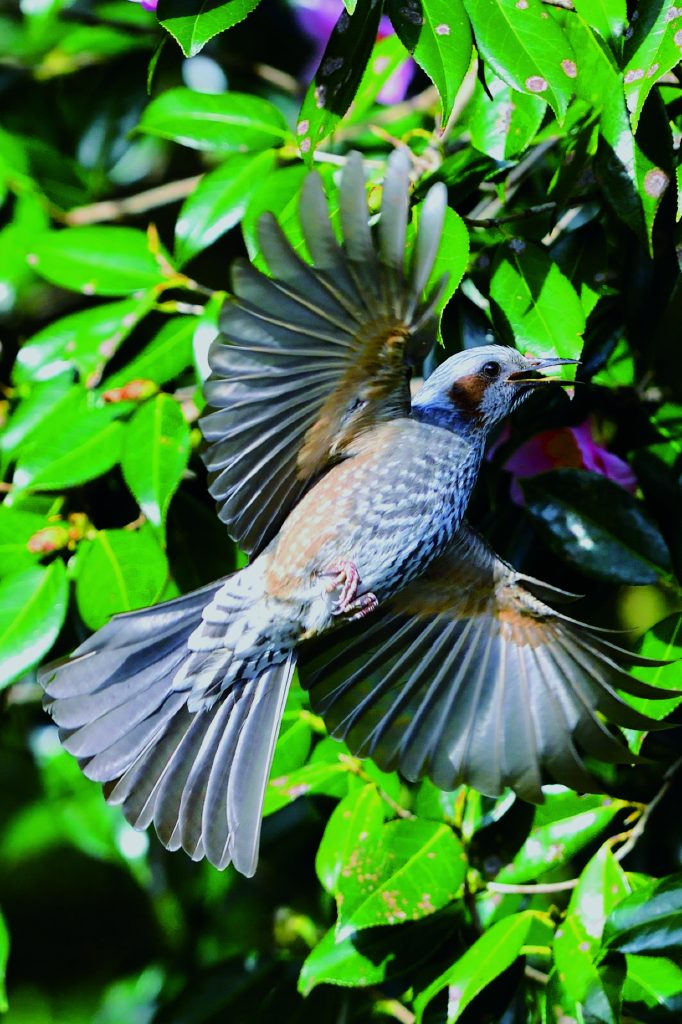
Whenever I step into my garden, a Brown-eared Bulbul will cry out loudly as a warning, and other birds will hastily take flight from the birdbath. Previously, I used to put out a feeding table during winter. If it happened to be empty, a Brown-eared Bulbul would sometimes flap its wings against the large glass window of the sunroom, flying straight up it from bottom to top. At that point, I could hardly fail to notice! Once food was replenished, other birds could also eat. I felt as though I had witnessed a small act of mutual support among the birds.
As mentioned earlier, the Brown-eared Bulbul is a familiar bird for Japanese people, and they inhabit the entire country. Yet populations ranging from Hokkaido to Kyushu and the Izu Islands, together with the resident birds of island regions such as Ogasawara, Amami, and Okinawa, are currently classified into eight subspecies, each with its own distinctive form and coloration. These can apparently be grouped into three larger categories, and there is even the possibility that they may someday be classified as three separate species. At present, the Brown-eared Bulbul is not globally threatened. However, if it were divided into three distinct species, the smaller island populations might be designated as Endangered.
The distribution of the species is centred in Japan. From now on, rather than saying dismissively, “Oh… it’s just a Brown-eared Bulbul,” I hope we will warmly observe and appreciate its handsome appearance and acrobatic movements.