Visiting the birds of Iceland
HIH Princess Takamado reflects on a recent trip to Iceland to photograph birds and explore the country's history.
“Through the Lens” Fujingahou Magazine, February 2026
Photos and text by HIH Princess Takamado
Photo edited by Koichi Fujiwara (NATURE’S PLANET)
Edited by Yuki Masuda (Fujingahou)
English version prepared by BirdLife International.
(This English translation is provided for reference only and does not constitute an official version)
In October 2025, I visited Iceland to attend the Arctic Circle Assembly at the invitation of the country’s former president Ólafur Ragnar Grímsson, who is the founder of the Arctic Circle organisation. This was my second visit to Iceland, but the first in 29 years. On that earlier trip, I stayed for just half a day to attend a luncheon with the president. This time, however, I was guided to sites related to bird conservation, photography and places where I could experience Iceland’s history. I would like to share my photos while my memories are still fresh.
27 cm
Charadriidae Family
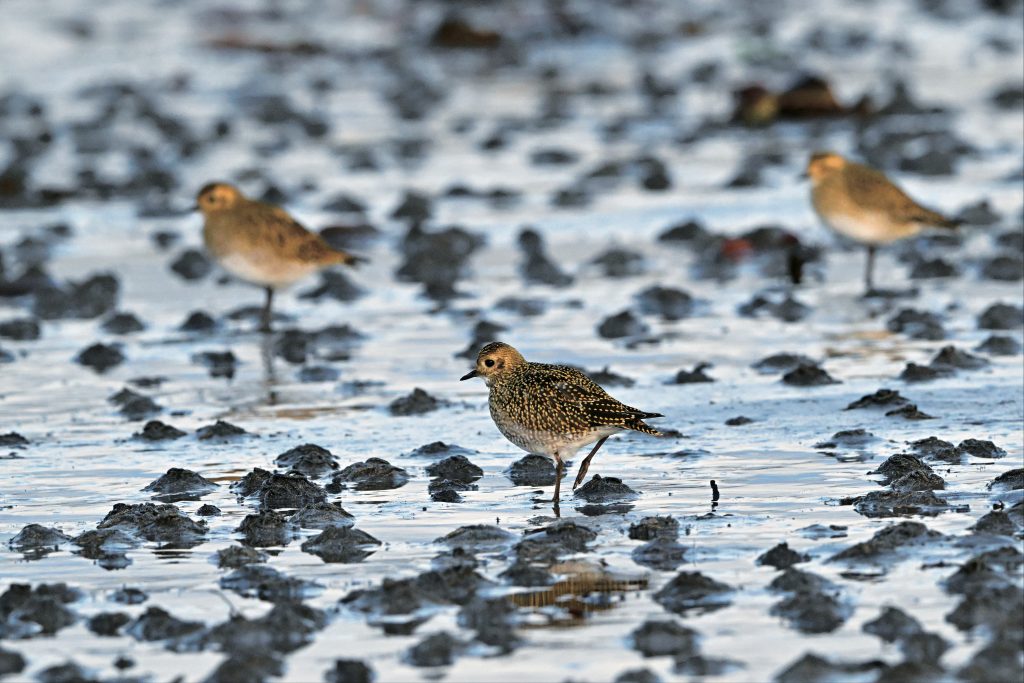
This species breeds in Arctic regions from Norway and Finland to the western part of Russia’s Taimyr Peninsula, and winters along the coasts of western Europe and the Mediterranean. In Japan, it has been recorded in Okinawa and Ishikawa. It is slightly larger and has shorter legs than the Pacific Golden Plover that migrates to Japan, giving a stockier impression. Its call sounds like “hee” or “pyoo,” which is quite different from the “kyobii” or “pyurii” calls of Pacific Golden Plover.
The first bird is Eurasian Golden Plover, seen here in non-breeding plumage (above). As its common name in English suggests, when the light hits it, its golden colour is truly beautiful. It closely resembles the Pacific Golden Plover, which migrates through Japan during the spring and autumn seasons.
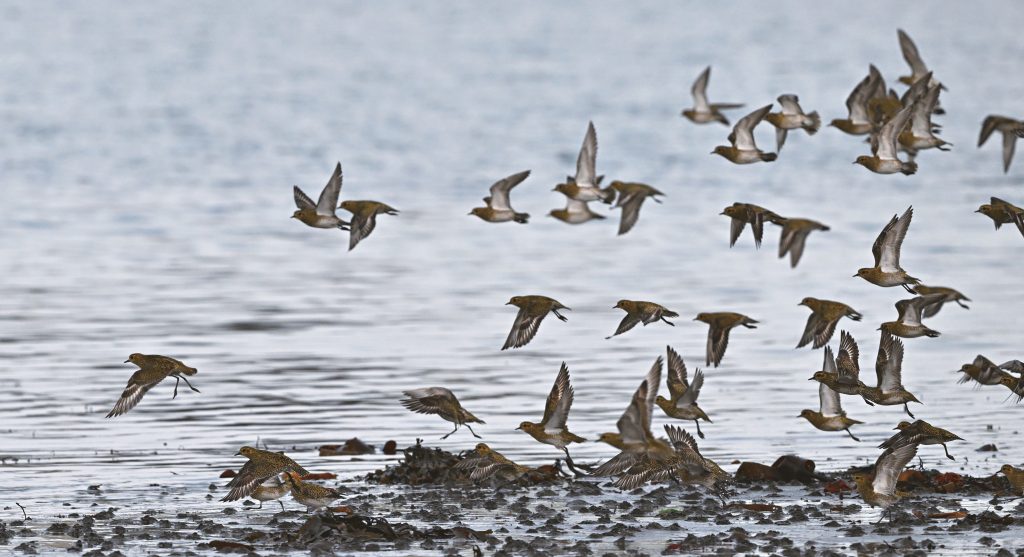
The second photo (above) captures the moment when the flock took flight after being startled by people who had come down to the shore. If you look closely, you can see that the Eurasian Golden Plover has white underwings and relatively short legs, so the tips of its toes do not extend beyond the tail feathers during flight. This flock circled in the air for quite some time before returning to the same beach, which was probably one of the birds’ favourite feeding grounds.
56 cm
Laridae Family
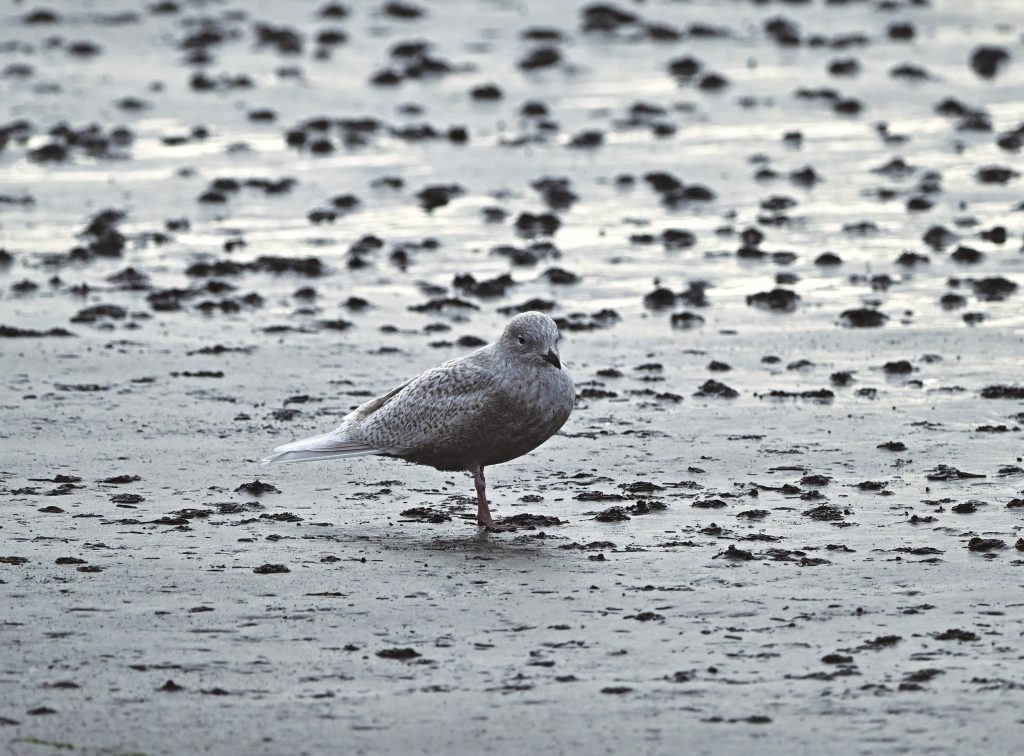
Some populations breed on Baffin Island and other areas of north-eastern Canada and migrate in winter to the Gulf of St. Lawrence and other parts of eastern North America. Others breed in Greenland and winter mainly around Iceland, with a small number migrating to the United Kingdom. In Japan, it has been observed in places such as Hokkaido and Chiba.
The photograph above shows a juvenile Iceland Gull. Compared to juveniles of other gull species, it is a much paler grey, giving a gentle impression. Before finding this young bird, I was also able to see the adults. When the Eurasian Golden Plovers took off, several gulls were resting with their eyes closed in the background. The adults were an overall very pale grey, and they appeared noticeably smaller than species such as European Herring Gull.
37 cm
Phasianidae Family
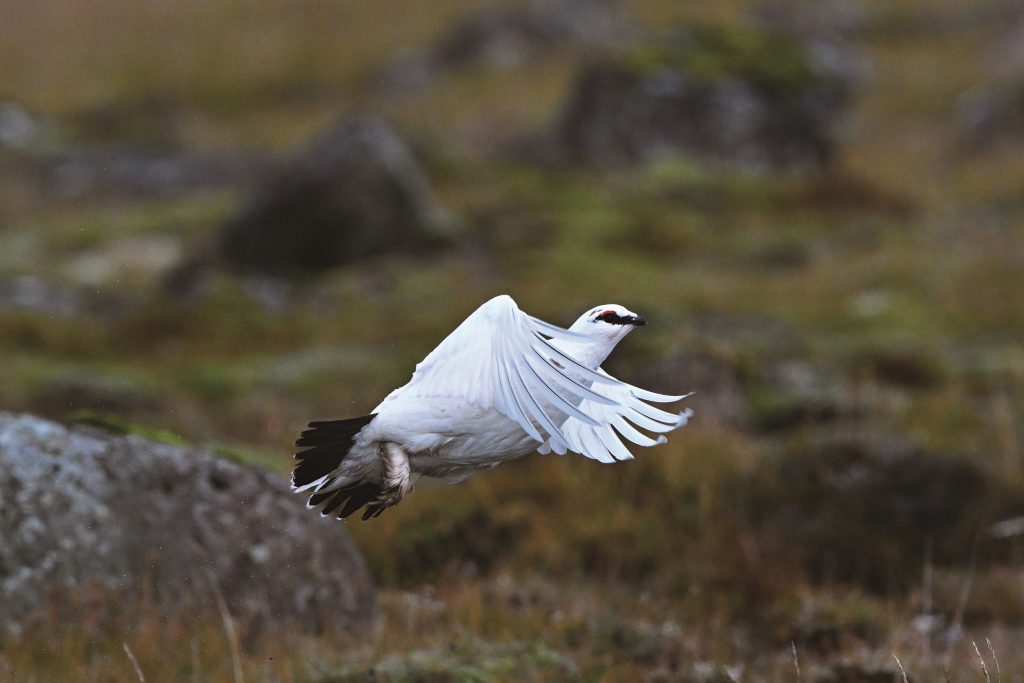
Widely distributed across the northern parts of the Eurasian and North American continents surrounding the Arctic. Japan’s Rock Ptarmigans inhabit high mountains in central Honshu in an isolated population at the southernmost edge of the species’ range. The next southernmost population after Japan is found in the Pyrenees, followed by the population in the European Alps. All of these populations are relic groups that were left behind in high mountain areas after the end of the last Ice Age.
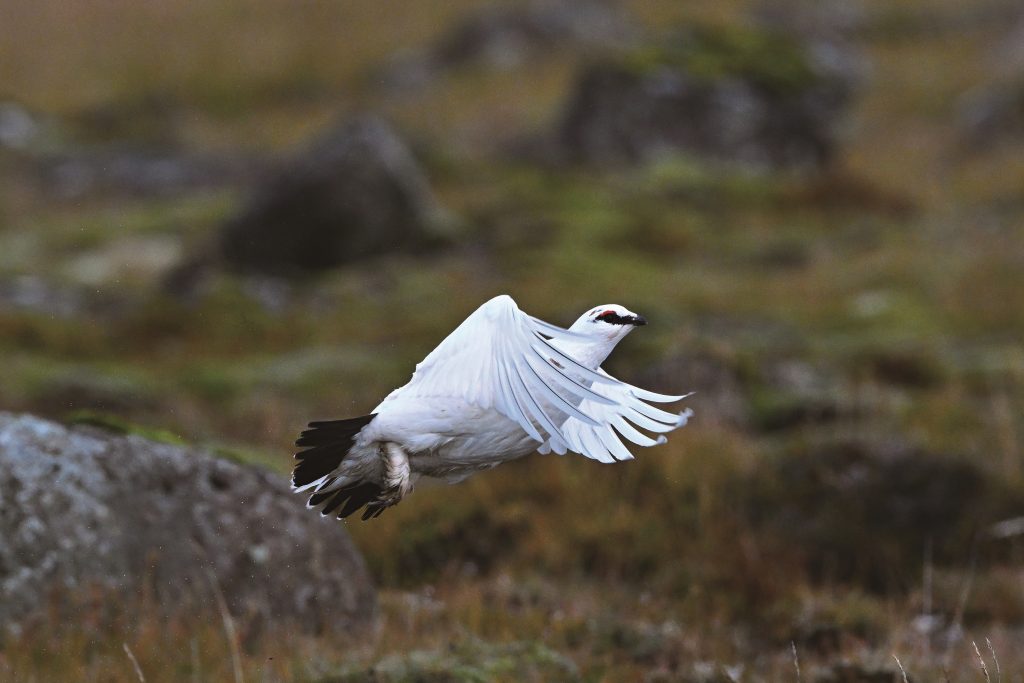
The final two photographs are of Rock Ptarmigans. The bird in the photo above had already moulted into pure white plumage. Although there was no snow at the time, I later heard that the first snowfall came about a week after I returned to Japan.
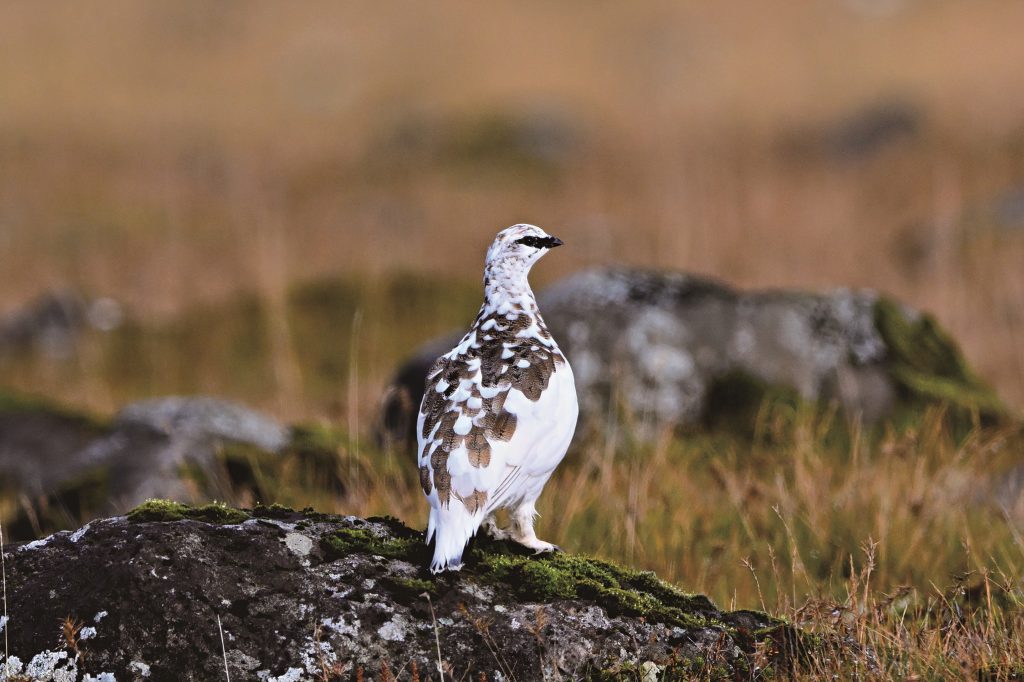
The ptarmigan in the last photo (below) was still in the middle of moulting, showing a mottled pattern of brown and white. As it was mid-October, this change in plumage occurred about a month and a half earlier than Japan’s Rock Ptarmigans. Individuals that inhabit Iceland and other Arctic regions moult twice a year: into breeding plumage and non-breeding plumage. In contrast, Japan’s Rock Ptarmigans, which live at the southernmost edge of the species’ range, have evolved an additional autumn moult. This is due to the long snow-free period, resulting in three moults per year.
I have photographed brown Rock Ptarmigans in Japan. However, I would have to climb snow-covered mountains in winter to see a white example in Japan! That would require considerable physical strength and technical skill, and if anything were to happen, it would cause trouble for many people. Thus, I had long given up on seeing a white Rock Ptarmigan with my own eyes on snowy winter mountains, considering it nothing more than a distant dream.
For us Japanese, Rock Ptarmigans are mountain birds. When a local bird expert stopped the car by the roadside and pointed out across the plains, saying, “There’s a Rock Ptarmigan over there,” I couldn’t quite grasp what he meant at first. Then, in the very next moment, my excitement soared at the sight of a wild white Rock Ptarmigan for the first time in my life. According to our guide, “Rock Ptarmigan are not particularly nervous birds, so it should be fine to approach with a tripod if it is just the two of us – they probably won’t fly away.” For the first time, I was able to approach a white Rock Ptarmigan. I took many photographs and felt extremely satisfied.
That morning, we observed a total of four Rock Ptarmigans at two locations. The two birds shown in the photographs shown represent the extremes – the whitest and the brownest – while the other two were in intermediate stages of moult. As their common name suggests, they live in rocky areas as can be seen in the photos. In Japan as well, Rock Ptarmigans were once called ‘rock birds.’ This is probably because such terrain is important for them as cover and shelter. The same is true in the Japanese Alps, where they are also found in areas with many rocks.
Iceland has a population of just under 400,000 people. Once you leave the capital city, Reykjavík, you hardly encounter anyone. Vast stretches of untouched nature have no one living there, which made me feel just a little envious.