Red de Observadores de Aves y Vida Silvestre (ROC) joins BirdLife International as a new Partner in Chile
Today, we welcome the 124th organisation to join the BirdLife International family which is now active in 119 countries and territories around the world!
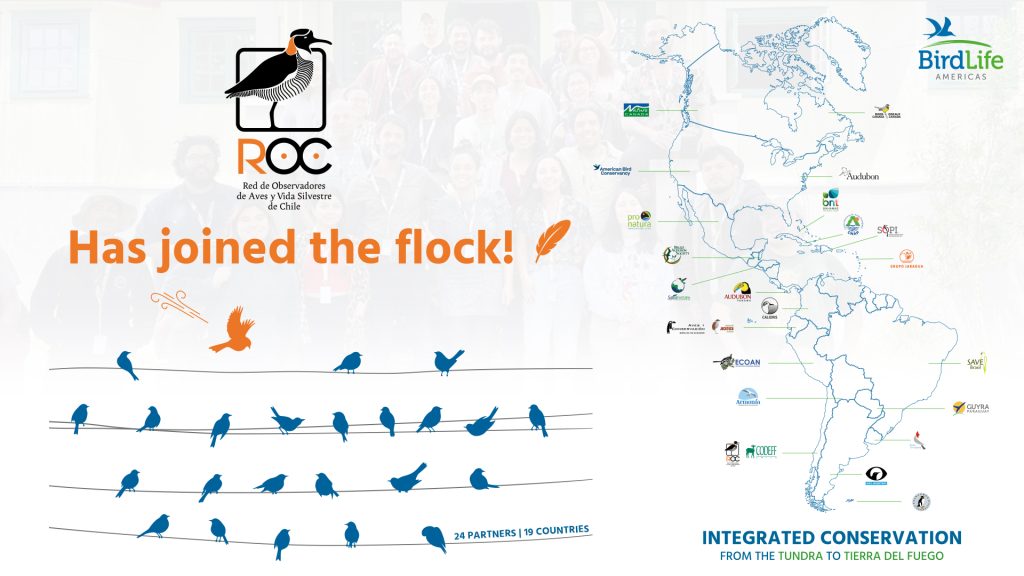
Red de Observadores de Aves y Vida Silvestre of Chile (ROC) has joined BirdLife International as the new national Partner, strengthening a global network that now includes 24 organizations in 19 countries in the Americas.
With more than a decade of experience in citizen science, flagship initiatives such as the Atlas of Breeding Birds of Chile (over 670,000 records and 1,800 observers), standardized shorebird protection protocols in 13 coastal localities, and a digital community exceeding 48,000 people, ROC brings data, technical capacity, and territorial action to key priorities such as AFI, Conserva Aves, and KBAs, consolidating Chile as a strategic hub for conservation with both local and global impact.
Measurable impact and nationwide citizen science
One of ROC’s most significant milestones is the Atlas of Breeding Birds of Chile, the largest citizen science project ever conducted in the country. This collective effort generated more than 670,000 records over a five-year period, with the participation of over 1,800 observers across Chile. The project also involved more than 80 specialists, who authored species accounts, and culminated in the publication of a nearly 700-page book, now considered a national and regional reference. The Atlas of Breeding Birds of Chile was also the first atlas of its kind published in Latin America, setting a precedent for the region.
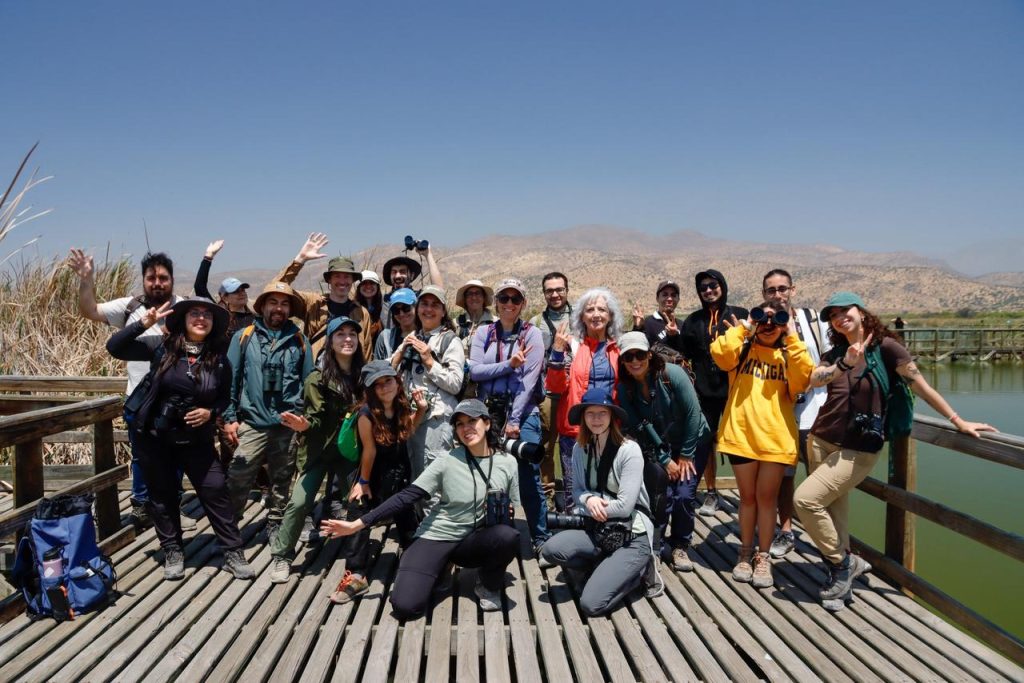
In the field of coastal conservation, ROC has led the implementation of various monitoring schemes for waterbirds and shorebirds, involving a community of hundreds of birdwatchers and ornithologists. In several coastal wetlands, the results of these studies have been key to the recognition of these sites as important areas, the creation of protection measures, and the implementation of management actions to mitigate threats, and strengthening the local capacities of communities.
Over the past decade, ROC has led research and conservation efforts involving various seabirds in Chile, particularly storm-petrels, discovering some of the most important breeding sites for several species in the Atacama Desert. This has led to the subsequent development of conservation plans and the implementation of protection measures, including the protection of sites.

“One of the principles of the ROC is collaboration, as we believe that collective efforts lead to better results. This is central to our organization, a “network of observers” that initially sought to advance knowledge of birds through citizen science projects. In recent years, ROC has matured, strengthening its conservation efforts. But to be effective, we must maintain this spirit of collaborative work. Thus, the best way to increase our impact on the conservation of birds and their habitats is to be part of an organization such as BirdLife, which is conceived as a partnership of more than 120 organizations. This is a significant milestone for us, opening up opportunities to forge alliances, contribute to broader initiatives, and learn from the experience of many others.” – Ivo Tejeda, Executive Director, ROC.



“The addition of ROC to BirdLife’s Partnership in the Americas strengthens our regional capacity to act where conservation outcomes are most needed. ROC brings deep territorial knowledge, strong citizen science foundations, and proven on-the-ground delivery. This partnership reinforces collaboration across countries and flyways, enabling us to scale impact in Chile while advancing shared regional priorities. Together, we will strengthen the implementation of Conserva Aves, the Americas Flyways Initiative, and Key Biodiversity Areas, translating regional strategies into tangible conservation results.’’ – Ian Davidson, Regional Director – Americas.
Programmatic areas and an integrated conservation approach
ROC’s work is structured around multiple programmatic areas that reflect a holistic approach to conservation. These include waterbirds and wetlands, conservation in Chile’s Norte Grande, environmental education, bird monitoring, bird festivals, and conservation planning. Together, these areas allow the organization to operate across the full conservation spectrum—from knowledge generation and community engagement to public awareness and policy-relevant action.
Leadership and trajectory
ROC is led by Ivo Tejeda, an avid birdwatcher with a professional background in social sciences and public policy, who has played a key role in the development of Chile’s birding community. For more than a decade, Ivo has promoted the creation and implementation of citizen science initiatives and has contributed to the design of conservation plans for groups of threatened species, including storm-petrels, the Peruvian Tern, and various shorebird species. His leadership has enabled ROC to combine technical rigor, social legitimacy, and a strong capacity to bridge citizens, science, and public management.
Regional and global contribution
ROC’s incorporation into BirdLife International strengthens key regional priorities, including the Americas Flyways Initiative (AFI), Conserva Aves, and the identification and management of Key Biodiversity Areas (KBAs), among others. Chile plays a critical role for migratory birds and for coastal, Andean, and Patagonian ecosystems, and ROC contributes local data, technical capacity, territorial presence, and community engagement to advance these agendas with both regional and global impact.
Becoming part of BirdLife International means joining a global network that connects local action with worldwide impact. For ROC, this partnership expands its influence, strengthens access to technical tools, and opens new opportunities for regional collaboration. For BirdLife, it represents the addition of an organization with a proven track record, measurable impact, and an active community, capable of translating global conservation goals into concrete results on the ground.
In a context of accelerating biodiversity loss and increasing pressure on ecosystems, ROC’s incorporation reaffirms a core principle: effective conservation begins locally, is built with people, and achieves global scale when carried out through strong networks along global flyways.

“Strengthening BirdLife’s presence in Chile through a Partner like ROC significantly enhances our ability to deliver conservation at scale across the Americas Flyways. Chile is a critical node for migratory birds, and having a strong, locally grounded organization enables better data, stronger coordination, and more effective action along the flyways. This partnership helps translate global priorities into tangible outcomes on the ground, where they matter most. We are excited to welcome ROC as part of BirdLife’s global partnership, strengthening our collective impact across flyways worldwide.” – Martin Harper, Chief Executive Officer.