Glimmer of hope: Sought-after lost bird rediscovered in India

After more than 20 years, the Critically Endangered Jerdon's Courser has been documented again.
24 August, 2025- Lankamalla Hills, Andhra Pradesh, India
Last week, a team of Indian birdwatchers recorded the call of a bird that had been lost to scientists for the past 16 years – the Jerdon’s Courser (Rhinoptilus bitorquatus). They had embarked on a personal journey to rediscover the bird just the day before.
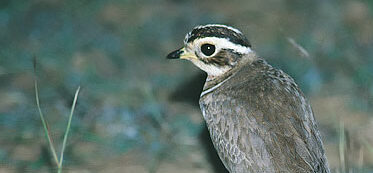
The Jerdon’s Courser is a brown bird with comparatively long legs and large eyes. These features allow the birds to navigate through the scrublands of Central India. Not only are Jerdon’s Coursers nocturnal, they’re also known to be shy. Pair that with its impressive brown camouflage, and the potential of finding the species becomes an extraordinary challenge.
Over the course of the past 125 years, this elusive bird has been lost, rediscovered and lost again. As such, it has been listed under the ‘Search for Lost Birds’ , a global partnership between BirdLife International, American Bird Conservancy (one of our Partners in the US), and Re:wild.
The lost birds on this list haven’t been documented for the past 10 years; for the Jerdon’s Courser that hasn’t happened for more than 20 years. Previously, the bird had only been documented using extensive surveys and camera traps around the Sri Lankamalleswara Wildlife Sanctuary. But there had been no modern records of the bird outside of this sanctuary, until now.
Alex Berryman, Senior Red List Officer at BirdLife International, commented on the discovery:
“Congratulations are due to all involved; this is an incredibly exciting rediscovery and one of the most sought-after lost birds. Finding and documenting Lost Birds is the obvious first step in implementing action to conserve them. Hopefully, additional search efforts (and some photos!) will follow so that we can better understand Jerdon’s Courser and what might be needed to save it from extinction.
Globally, there remain more than 110 Lost Birds, many of which are thought to be on the verge of extinction. For these species the urgency to find them could not be greater.”
Harish Thangaraj grew interested in finding this bird several months ago after reading a description that was written by one of the last people to have seen the bird. Together with Shashank Dalvi, Adesh Shivkar, Ronith Urs, Pranav, the group poured over research on the species and sought out other locations with similar scrubland to Sri Lankamalleswara Wildlife Sanctuary. They believed there was a possibility that these areas could be prime habitat for this shy creature. Their research spanned the months of July and August, culminating into a field trip during the final week of August. Merely one day after setting off on their quest, the team heard and recorded the bird.
Parveen Shaikh, Scientist at the Bombay Natural History Society (our Partner in India), who studies birds in the region, added:
“It means there is a hope for this species. And I am hopeful that further efforts to find the birds might yield positive results.”
These incredible recordings of a simple two-note call teach us several lessons. First, that birders play a vital role in our scientific understanding of all bird species. Next, that the range of these birds expands beyond where previous research has been conducted. And lastly, that there is still hope that many of our ‘lost’ species may one day be found.